

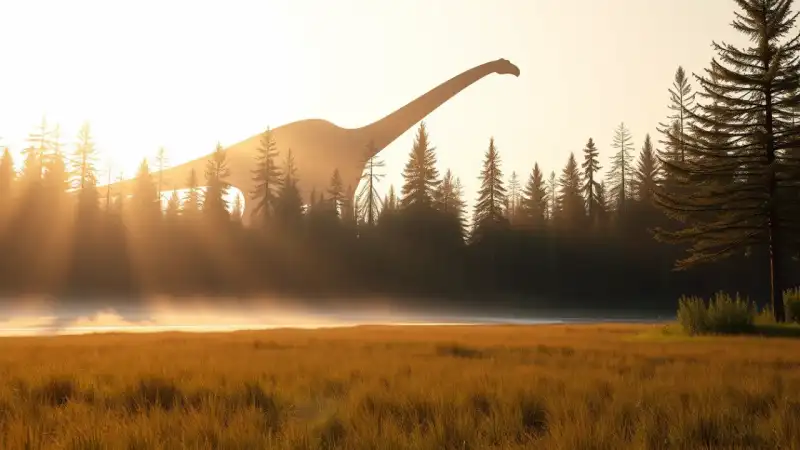
Brachiosaurus altithorax was special because it was built like a giraffe: its front legs were longer than its back legs, so its body sloped upward to a neck that reached high into the treetops. This Late Jurassic sauropod, which lived roughly 154 to 150 million years ago, also ranked among the largest animals to walk North America.
Its name means “arm lizard,” a nod to those long forelimbs. Here is what set it apart.
For the bigger picture, read Long Neck Dinosaur: Names, Sizes, and Why Their Necks Grew So Long.
What made Brachiosaurus different from other dinosaurs?
- Front legs longer than back legs. Brachiosaurus had forelimbs that outstretched its hind limbs, which gave its back an upward slope. Many other sauropods had a back that was level or sloped down toward the tail.
- A neck angled steeply upward. This posture let Brachiosaurus act as a high browser, an animal that feeds on foliage far above the ground, such as the upper branches of conifers.
- Enormous size. Brachiosaurus reached about 59 to 72 feet (18 to 22 meters) long and roughly 40 feet (12 to 13 meters) tall, about the height of a four-story building.
- Huge weight. Estimates run from about 31 to 55 short tons (28 to 50 metric tons), and the range depends on how researchers reconstruct its body.
- A relatively short, muscular tail. Compared with Diplodocus, which had a long whip-like tail, Brachiosaurus carried a shorter tail that balanced its heavy front end.
- Nostrils high on the skull. Its skull had a prominent bony arch, with the external nostrils sitting near the top of the head.
Why did Brachiosaurus have such a tall build?
Brachiosaurus was shaped for reaching food that smaller plant eaters could not. Think of a person on a tall stepladder: the extra height opens up a whole shelf nobody else can get to.
It ate plants, including leaves, ferns and conifers, taking them from the upper canopy. Large size also helped a sauropod (a giant, long-necked, four-legged plant eater) deter predators, since few meat eaters could take on an animal that big.
Where and when did Brachiosaurus live?
Brachiosaurus lived in western North America during the Late Jurassic. The first fossils were found in 1900 in the Colorado River valley of western Colorado by the American paleontologist Elmer S. Riggs, who formally described the animal in 1903. More remains have been found in the Morrison Formation, a rock layer in the American West that preserves many Jurassic dinosaurs.
How does Brachiosaurus compare with Diplodocus?
The key difference is posture and proportions: Brachiosaurus was tall and front-heavy, while Diplodocus was long and low with a whip-like tail.
| Feature | Brachiosaurus | Diplodocus |
|---|---|---|
| Limbs | Front legs longer than back legs | Forelimbs slightly shorter than hind limbs |
| Body slope | Rises toward the shoulders | Fairly level |
| Tail | Relatively short and muscular | Long and whip-like |
| Feeding style | High browser | Long-necked, quadrupedal grazer of vegetation |
Common mix-ups about Brachiosaurus
- It was not the longest dinosaur. Its fame comes from height and bulk, not record length.
- It was a plant eater. Brachiosaurus was a herbivore and not a hunter.
- Its tail was not like Diplodocus’s. The tail was shorter and thicker.
FAQ
– How big was a Brachiosaurus?
Brachiosaurus measured about 59 to 72 feet (18 to 22 meters) long and up to roughly 40 feet (12 to 13 meters) tall. Its weight is estimated at about 31 to 55 short tons.
– What does Brachiosaurus mean?
Brachiosaurus means “arm lizard.” The name comes from Greek words for arm and lizard and refers to its unusually long front legs.
– What did Brachiosaurus eat?
Brachiosaurus ate plants. It fed on leaves, ferns and conifers, reaching the upper parts of trees with its tall neck.
– Where did Brachiosaurus live?
Brachiosaurus lived in western North America. Fossils come from Colorado and the Morrison Formation.