

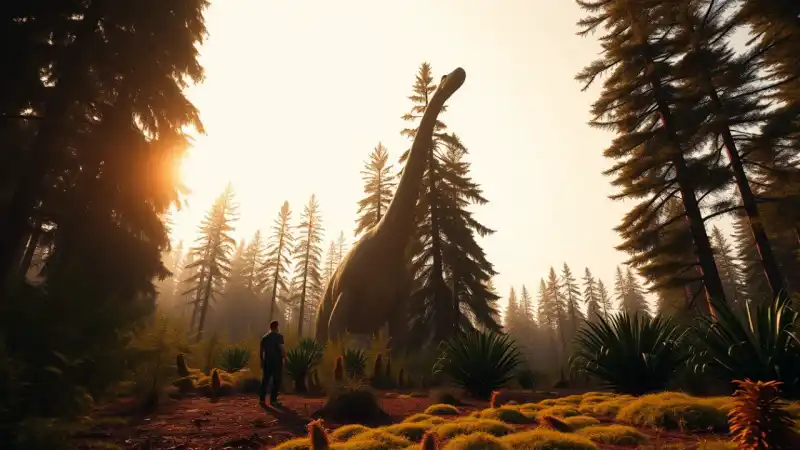
The long neck dinosaur is a sauropod, a group of huge, plant-eating, four-legged dinosaurs that includes Brachiosaurus, Diplodocus, Brontosaurus and Mamenchisaurus. Brachiosaurus altithorax, from the Late Jurassic about 154 to 150 million years ago, is the best-known example, reaching roughly 59 to 72 feet (18 to 22 meters) long.
Sauropods dominated many ecosystems for well over 100 million years. Their necks evolved for several reasons at once, covered below.
Why did sauropods have such long necks?
- Reaching high food. A tall neck let a Brachiosaurus-type animal feed on leaves, ferns and conifers in the upper tree canopy that shorter plant-eaters could not reach.
- Feeding without moving. A long neck on a low-slung sauropod like Diplodocus could sweep a wide area of plants while the heavy body stood still, saving energy.
- Large size as protection. Researchers generally agree that great body size helped shield sauropods from predators, and a long neck was part of that size.
- Light, air-filled bones. Sauropod neck vertebrae had air spaces connected to the breathing system, which made the neck far lighter than solid bone would be.
- A small head. Sauropods swallowed plants with little chewing, so the head stayed small and light at the end of the neck.
How did a neck that long stay light enough to lift?
Sauropod neck bones were hollow in places, filled with air pockets linked to the lungs. Think of a bicycle frame: hollow tubes give strength without the weight of solid metal.
A vertebra is one bone of the spine. The air-filled design let sauropods grow necks that would be impossibly heavy in an animal with solid bones.
What are the main long-necked dinosaurs?
| Dinosaur | Body shape | Notable feature |
|---|---|---|
| Brachiosaurus | Front legs longer than back legs, sloping upward | Giraffe-like posture, relatively short tail, nostrils on a bony arch on the skull |
| Diplodocus | Long, level body | Long, whip-like tail; forelimbs slightly shorter than hind limbs |
| Brontosaurus | Long-necked sauropod | Related to Diplodocus; often compared with it and Brachiosaurus |
| Giraffatitan | Brachiosaur-type build | Very long neck |
| Mamenchisaurus | Extremely long neck | Fossils from China; thought to have had the longest neck of all |
What was special about Brachiosaurus?
Brachiosaurus was special for its upright, giraffe-like build: its front legs were longer than its hind legs, so its back sloped upward and its neck angled steeply toward the sky. Its name means “arm lizard” for that reason.
- Size: about 59 to 72 feet (18 to 22 meters) long and up to roughly 40 feet (12 to 13 meters) tall.
- Weight: estimated at 28 to 50 metric tons (31 to 55 short tons).
- Diet: plants only, taken from high branches.
- Tail: relatively short and muscular compared with Diplodocus.
- Skull: a bony arch with the nostrils set near the top.
Where did Brachiosaurus live, and who found it?
Brachiosaurus lived in what is now western North America, in the Late Jurassic. Paleontologist Elmer S. Riggs found the first fossils in 1900 in the Colorado River valley of western Colorado and described the animal in 1903. More remains come from the Morrison Formation, a layer of rock rich in Jurassic fossils.
What is the difference between Brachiosaurus and Diplodocus?
The core difference is posture: Brachiosaurus stood tall with its neck held high and a short tail, while Diplodocus had a level body, a long neck and a very long whip-like tail. Brachiosaurus fed high in trees; Diplodocus is generally pictured sweeping its neck across a broad area.
Common myths about long-necked dinosaurs
- Myth: they lived in water. The popular image of a sauropod snorkeling with its nostrils on top is a misreading of the skull. These were land animals.
- Myth: all had the same shape. Some held their necks high, while others had low, level bodies and enormous tails.
- Myth: Brachiosaurus was the longest. Mamenchisaurus is thought to have had the longest neck of all.
FAQ
– What is the name of the dinosaur that has a long neck?
Long-necked dinosaurs are called sauropods. Brachiosaurus, Diplodocus, Brontosaurus, Giraffatitan and Mamenchisaurus are among the best-known.
– What is the size of a Brachiosaurus?
Brachiosaurus measured about 59 to 72 feet (18 to 22 meters) long and up to about 40 feet (12 to 13 meters) tall. That is roughly the height of a four-story building.
– How much did a Brachiosaurus weigh?
Brachiosaurus is estimated to have weighed 28 to 50 metric tons, or 31 to 55 short tons. Estimates vary because they are worked out from incomplete skeletons.
– Did long-necked dinosaurs eat meat?
No, sauropods were herbivores. Brachiosaurus ate leaves, ferns and conifer needles from tall trees.
– Which dinosaur had the longest neck?
Mamenchisaurus is thought to have had the longest neck of any dinosaur. Its fossils were found in China.