

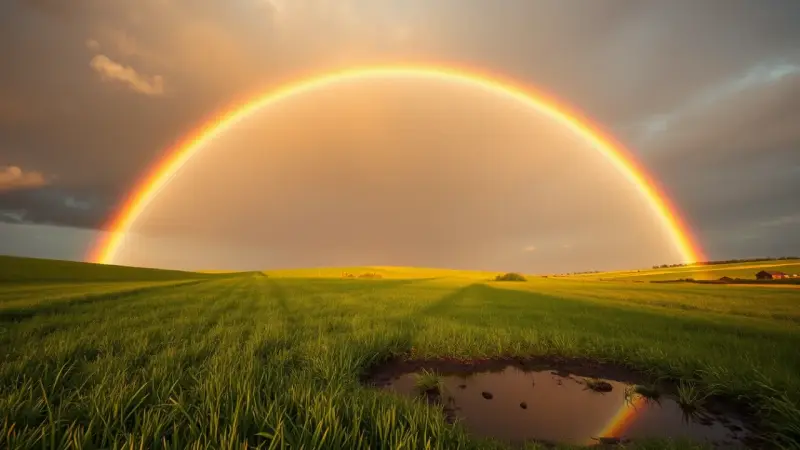
The colors of the rainbow in order are red, orange, yellow, green, blue, indigo and violet, a sequence you can remember as ROY G. BIV. Red always sits on the outer edge of the arc and violet on the inner edge, because each color of sunlight bends by a slightly different amount as it passes through raindrops.
That order is set by physics, not by tradition, so it holds for every rainbow you will ever see. What does change is how many color names people use to describe it, and which way the colors run in a double rainbow.
The 7 colors of the rainbow in order
The seven rainbow colors, from the outside of the arc to the inside, are listed below. Each step moves from longer wavelengths of light to shorter ones.
- Red. Red is the outermost band of a rainbow and has the longest wavelength of visible light.
- Orange. Orange sits just inside red and blends into it with no sharp edge.
- Yellow. Yellow is often the brightest-looking band, because the human eye is especially sensitive to light in the yellow-green range.
- Green. Green falls in the middle of the rainbow, roughly halfway between the two ends of the visible spectrum.
- Blue. Blue lies inside green and marks the start of the shorter, more strongly bent wavelengths.
- Indigo. Indigo is a deep blue-violet between blue and violet, and it is the hardest band for most eyes to pick out.
- Violet. Violet is the innermost band of a rainbow and has the shortest wavelength of visible light.
Listed in reverse, from inside to outside, the same colors spell VIBGYOR, a version of the mnemonic taught in some countries. Both are correct; they simply start from opposite edges.
Rainbow colors and their wavelengths
A wavelength is the distance between the peaks of a light wave, and it is what your eye reads as color. Visible light runs from about 700 nanometers (red) down to about 400 nanometers (violet). The boundaries below are approximate, because the spectrum is continuous and the cutoffs between named colors differ by source.
| Position (outside to inside) | Color | Approximate wavelength (nm) | How much it bends |
|---|---|---|---|
| 1 | Red | 620-700 | Least |
| 2 | Orange | 590-620 | Less |
| 3 | Yellow | 570-590 | Moderate |
| 4 | Green | 495-570 | Moderate |
| 5 | Blue | 450-495 | More |
| 6 | Indigo | 425-450 | More |
| 7 | Violet | 400-425 | Most |
Why rainbow colors always appear in the same order
Rainbow colors always appear in the same order because water bends short wavelengths more than long ones. A rainbow forms when sunlight enters millions of falling raindrops, bends, reflects off the back of each drop and bends again on the way out.
- Refraction. Refraction is the bending of light as it moves from one material into another, such as from air into water.
- Dispersion. Dispersion is the splitting of white light into its colors, which happens because each wavelength refracts by a slightly different amount. Violet bends the most, red the least.
- Reflection. Inside the drop, the light bounces off the far side and heads back toward you, leaving at a slightly different angle for each color.
Red light exits the drops at a slightly wider angle than violet light, so the red you see comes from drops higher in the sky and the violet from drops a little lower. That is why red lands on the outside of the arc. A glass prism on a sunny windowsill does the same thing on a small scale, fanning a beam of white light into a strip of color.
To see a rainbow, the sun has to be behind you and rain or mist in front of you. The arc is centered on the point directly opposite the sun, and the bright primary bow sits about 42 degrees from that point. From an airplane or a high viewpoint, a rainbow can appear as a full circle, because the ground no longer cuts off the bottom half.
Why is indigo in the rainbow?
Indigo is in the rainbow because Isaac Newton included it when he named the colors of the spectrum in the late 1600s. Newton chose seven colors to match the seven notes of the musical scale, which he believed reflected a natural harmony. Indigo, a dye color well known in his day, filled the gap between blue and violet.
A real rainbow is a smooth gradient with no lines between colors, so any count is a convention. Many people find indigo hard to tell apart from blue or violet, and you can test this yourself the next time you see a bright rainbow: try to find where blue ends and violet begins. The answer is fuzzy, which is exactly why the number of named colors is a choice rather than a measurement.
What are the six main colors of the rainbow?
The six main colors of the rainbow, in the simplified version, are red, orange, yellow, green, blue and violet (or purple). This list drops indigo and folds it into its neighbors. It is common in art classes and color wheels, where purple is treated as one of the basic colors.
Neither list is wrong. The seven-color ROYGBIV list is the traditional science answer, and the six-color version describes what most eyes can comfortably distinguish. If a homework question asks for the colors of the rainbow in order, ROYGBIV is the safe answer.
What is the rhyme to remember the rainbow colors?
The best-known memory aid for rainbow colors in the US is the made-up name ROY G. BIV, where each letter stands for one color in order. In Britain, children often learn the sentence “Richard Of York Gave Battle In Vain,” in which the first letter of each word gives red, orange, yellow, green, blue, indigo, violet.
Two quick checks keep you from mixing up the order:
- Warm to cool. The rainbow runs from warm colors (red, orange, yellow) on the outside to cool colors (blue, indigo, violet) on the inside, with green in the middle.
- Long to short. The order always follows wavelength, from the longest (red) to the shortest (violet).
What is a double rainbow?
A double rainbow is a second, fainter rainbow that appears outside the main one, and its colors run in reverse order. In the secondary bow, red is on the inside and violet on the outside.
The secondary rainbow forms when light reflects twice inside each raindrop instead of once. The extra bounce flips the color order and loses more light, which is why the outer bow looks paler. The sky between the two bows often looks darker than the sky around them; this strip is called Alexander’s dark band, after the ancient Greek thinker Alexander of Aphrodisias, who described it.
FAQ
– How many colors are in a rainbow?
A rainbow is traditionally said to have seven colors: red, orange, yellow, green, blue, indigo and violet. In reality, a rainbow contains a continuous blend of colors with no fixed dividing lines. The count of seven is a naming convention that dates back to Isaac Newton.
– What are the real rainbow colors?
The real colors of a rainbow are every wavelength of visible light, blending smoothly from red to violet. Named bands like orange or indigo are labels people place on that gradient. Rain conditions can also change how a rainbow looks, with larger drops producing brighter, more vivid colors.
– Does a rainbow ever change its color order?
No, a primary rainbow always runs red on the outside to violet on the inside. The only common exception is the secondary bow of a double rainbow, where the order is reversed because of the second reflection inside each raindrop.
– Why can you never reach the end of a rainbow?
You can never reach the end of a rainbow because a rainbow is not an object in one place. It is an angle of light between the sun, the raindrops and your eyes, so the arc moves with you as you walk. Two people standing apart are actually seeing light from different raindrops.