

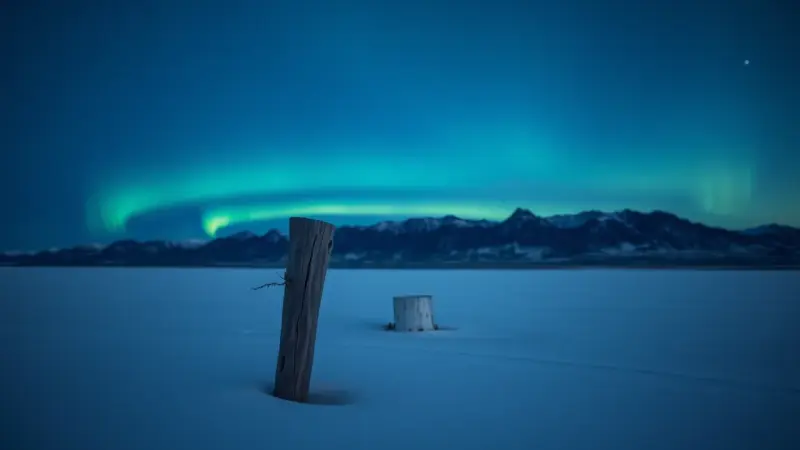
The northern lights (aurora borealis) occur almost every night of the year, because charged particles from the sun constantly reach Earth’s upper atmosphere. Whether you can see them depends on darkness, clear skies and solar activity: in places like northern Norway, Iceland, Alaska and northern Canada, that works out to roughly 75 to 150 or more nights a year.
Farther south, the picture changes sharply. The lights shift from a routine event near the Arctic to a rare treat that needs a strong burst of solar activity.
What decides how often the northern lights happen?
Four factors decide how often you can see the northern lights: where you are, the time of year, the solar cycle and the weather.
- Latitude. The aurora is strongest in a ring around the magnetic pole called the auroral oval. Places under that ring, such as northern Norway, Iceland, Alaska and northern Canada, see displays most often.
- Darkness. The aurora glows all day, but sunlight washes it out. You need a properly dark sky, which means winter nights far north and a late-night window farther south.
- Solar activity. More sunspots and coronal mass ejections (huge clouds of solar plasma thrown into space) mean more geomagnetic storms and brighter, wider displays.
- Clear skies. Clouds block the view completely, so even a strong display can go unseen under an overcast sky.
How many nights a year can you see the northern lights?
Under the auroral oval, the northern lights are visible on roughly 75 to 150 or more nights a year in a typical year, and more often during active periods. That figure assumes you can pick the dark months and get lucky with cloud cover.
| Situation | How often you can see the aurora | Why |
|---|---|---|
| Under the auroral oval (northern Norway, Iceland, Alaska, northern Canada) | Roughly 75 to 150+ nights a year | You sit beneath the ring where the aurora is strongest |
| Lower latitudes, quiet sun | Seldom | The aurora stays close to the magnetic poles |
| Lower latitudes, strong geomagnetic storm | Occasionally | Storms push the aurora farther south than usual |
| Polar summer, May to July | Not visible | Midnight sun and constant daylight |
Which months and hours are best for seeing the northern lights?
The viewing season for the northern lights runs from late August to mid-April, when nights are dark enough. From May to July, and for most of August, the midnight sun and near-constant daylight in polar regions make the aurora impossible to see.
Within that season, the odds are not equal. A 75-year study by retired NASA solar physicist David Hathaway found that March has more geomagnetically active days than other months, which fits the long-observed pattern of stronger activity around the spring and fall equinoxes.
Time of night matters too. The best window is generally between 10 p.m. and 2 a.m. local time, when the sky is darkest. A cold night is not required: the lights occur year-round, and winter simply offers more darkness.
How does the 11-year solar cycle change the odds?
The sun runs on an roughly 11-year cycle of activity, and the northern lights become more frequent and widespread near its peak. At the peak, called solar maximum, the sun produces more sunspots and more coronal mass ejections, which trigger frequent geomagnetic storms.
A geomagnetic storm is a disturbance in Earth’s magnetic field caused by a surge of solar particles. During one, the aurora brightens and spreads well south of its usual zone. At solar minimum, the quiet phase, auroras still happen, but they stay closer to the magnetic poles and appear less often outside polar regions.
Recent years have been active ones in the current cycle, which is why many people far from the Arctic have seen the lights more than they expected.
How often can you see the northern lights in the United States?
In the United States, the northern lights are a regular sight in Alaska and an occasional one in the northern Lower 48, usually only when a strong geomagnetic storm hits. Most of the country sits too far south for the aurora to appear overhead on a normal night.
The May 2024 storm showed what a major event can do: displays reached far into the southern states. Events that strong are not routine, so check the forecast instead of waiting for a lucky night.
- Check the forecast. NOAA’s Space Weather Prediction Center publishes live aurora forecasts and geomagnetic conditions.
- Look for the Kp index. Kp is a scale of geomagnetic activity; higher numbers mean the aurora reaches farther from the poles.
- Get away from city lights. A dark site with a clear view north improves your chances at any latitude.
- Be patient. Activity comes and goes during the night, so a quiet sky at 10 p.m. can look different at midnight.
How long does a northern lights display last?
A northern lights display usually has distinct active phases of about 15 to 30 minutes, followed by a quieter spell before activity may return. Many people give up during the lull and miss the next round, so stay out longer than a single burst.
Common myths about northern lights frequency
- Myth: the lights only appear in winter. The aurora occurs all year; winter just brings the long dark nights that make it visible.
- Myth: it has to be freezing. Cold weather does not cause the aurora. Clear, dark skies and solar activity do.
- Myth: the lights switch off in summer. They keep going. In the Arctic summer, the sun simply drowns them out.
FAQ
– Are the northern lights visible all year?
No, the northern lights are not visible all year, even though they occur all year. Sunlight hides them from May to July, so the viewing season in the far north runs from late August to mid-April.
– What colors are the aurora borealis?
The aurora borealis shows up mainly in green, with red, blue and purple appearing in stronger displays. The colors come from particles striking gases in the upper atmosphere: oxygen produces green and red, while nitrogen adds blue and purple.
– Why do the northern lights only happen in the north?
The northern lights cluster near the Arctic because Earth’s magnetic field guides solar particles toward the magnetic poles. The same process creates the aurora australis around the South Pole.
– Are the northern lights dangerous?
The northern lights are harmless to people watching them from the ground. The strong geomagnetic storms behind the biggest displays can, however, disrupt satellites, radio signals and power systems.